Can Ashes Be Kept at Home?
Yes, ashes can be kept at home in Singapore. What that actually looks like, the 安灵 observance period, what to think about long-term, and when families move to a columbarium.
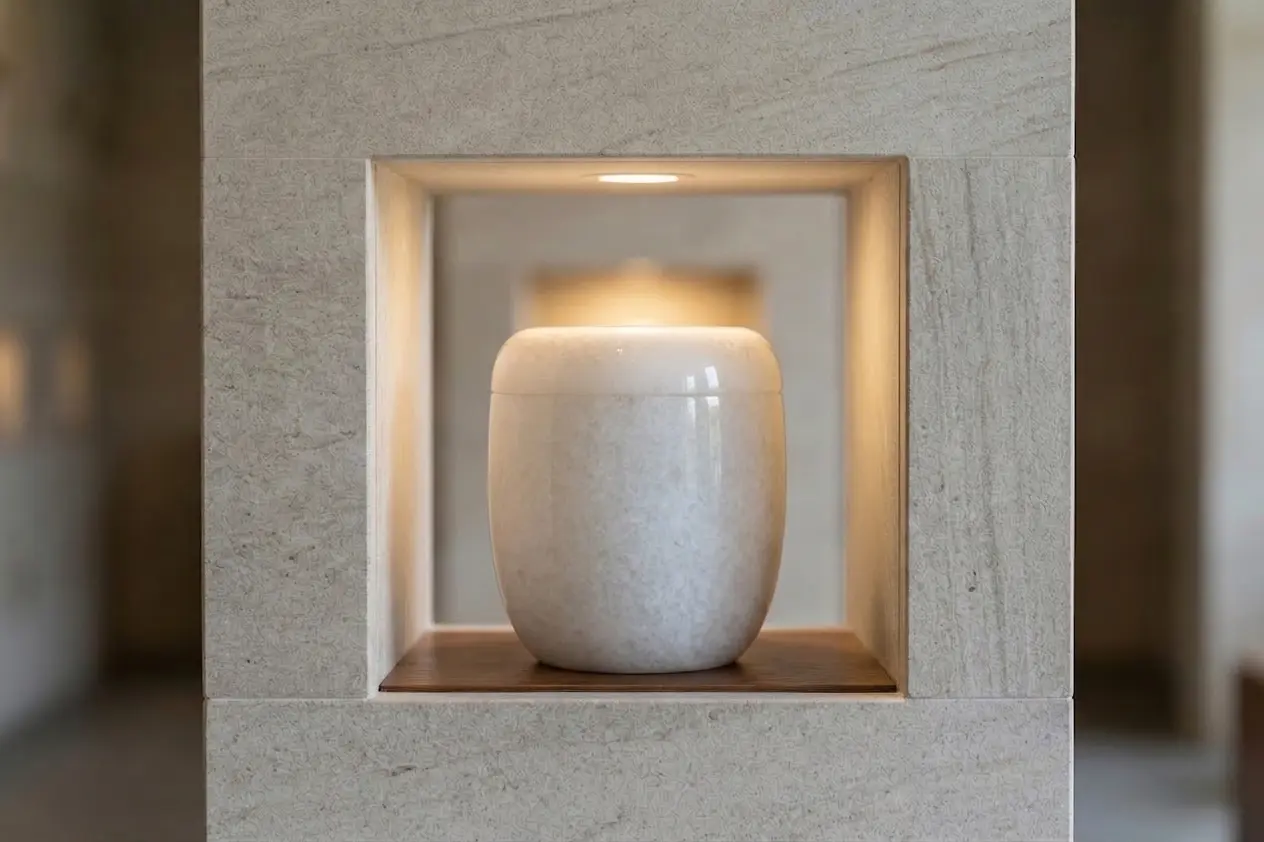
Yes. Ashes can be kept at home in Singapore. There is no law requiring cremated remains to be placed in a columbarium, and no permit is required to keep an urn at a private residence.
For many families this is a deliberate choice, sometimes temporary and sometimes permanent. Understanding what it involves in practice makes it easier to decide whether it is the right arrangement for your family.
The short version: Keeping ashes at home is legal and common, no permit needed. The question that actually determines whether the arrangement holds up is not whether you can, it's whether the whole household is genuinely aligned on it, and who will hold responsibility for the urn years from now. Families who skip that conversation are the ones who tend to run into difficulty later.
What Home Storage Actually Looks Like
The setup varies by family, but two patterns are common.
A dedicated altar or memorial space. Many families set up a small altar, often with a portrait of the deceased alongside the urn. This is particularly common in Buddhist and Taoist households, where the altar may already serve a ritual purpose in the home. Some families place scriptures on top of the urn, or wrap the urn in a cloth bearing scriptures.
A shelf or cabinet. Others keep the urn on a shelf or inside a display cabinet, in a quiet corner of the home, without a formal altar structure. This is more common in non-religious or Christian households, or in families who prefer a less visible arrangement.
Both approaches are practiced and both are appropriate. There is no single correct way to keep ashes at home, and what works depends on the family's beliefs, household layout, and the comfort level of everyone in the home.
The 安灵 Observance Period
For Buddhist and Taoist families, the period immediately after cremation often involves a structured observance known as 安灵. The standard duration is 49 days, though some families observe for up to 90 days.
During this period, prayers are offered for the deceased at regular intervals, often every seventh day. The observance may take place at the columbarium, at a temple or place of worship, or at home. Some families carry out the full 49-day observance before moving the ashes to a columbarium. Others complete it at the columbarium itself.
This is a meaningful reason why many Buddhist and Taoist families keep ashes at home initially, even if they plan to move to a columbarium later. If you are in this situation, the 49-day period is a natural point at which to revisit the placement decision.
For Christian, Catholic, free-thinker, and other families, there is generally no equivalent post-cremation observance period. The timeline for deciding on placement is more flexible.
Practical Considerations
Household comfort. Not every family member feels the same way about having an urn in the home. In multi-generational households, younger or older members can have different responses. An open conversation early surfaces these differences before they become a source of tension.
Space in Singapore homes. Most Singapore flats and condominiums are not large. A dedicated altar or a prominent shelf placement is a real commitment of space that works for some households and not others. Worth being honest about this at the start rather than discovering it is impractical a month in.
Long-term responsibility. If ashes remain at home for years or decades, the question of who holds responsibility becomes important. What happens if the household moves? Who takes responsibility in the next generation? These are worth thinking through even if the arrangement starts as temporary, because temporary arrangements have a way of becoming permanent.
What I've Noticed From the Families I Sit With
Most families who keep ashes at home have made a considered decision, either as a deliberate choice that fits their beliefs and circumstances, or as a financially sensible arrangement. Some have simply found it meaningful to have the person nearby and see no reason to change that. Others are navigating genuine financial constraints. Neither requires justification.
What I notice is that the arrangement works smoothly when the whole household is aligned on it from the start, and when someone has thought through what happens to the urn as the family's circumstances change over time. The families who encounter difficulty are the ones where one person made the arrangement, and years later, nobody else feels ownership over it or knows what to do.
The question I would suggest sitting with is not "is it legal" or even "is it appropriate." It is: "who in this family will feel responsible for this urn in ten years, and are they comfortable with that?"
When Families Move to a Columbarium
Many families start with home storage and later decide on a columbarium. The most common triggers are a household move, a change in family circumstances, or a point where the family is ready to establish a more permanent memorial arrangement.
If you are considering a columbarium, the Public vs Private Columbarium: What the Comparison Actually Involves covers the main differences, and How to Choose a Columbarium Niche: What to Notice When You Visit covers what to look for when selecting a niche. The Columbarium Singapore Guide provides a broader overview.
A columbarium provides a fixed location for family members to visit over time, which families find becomes more important as years pass and the home itself changes hands.
Related Guides
- What Happens After Cremation: The Decisions Your Family Will Face
- Can Ashes Be Scattered Anywhere? What the Rules Actually Allow
- Public vs Private Columbarium: What the Comparison Actually Involves
- Columbarium Singapore Guide
Final Thoughts
Keeping ashes at home is legal, practiced, and for many families the right arrangement. What it works best with is a household that is genuinely aligned on the decision, some thought about who holds responsibility over time, and clarity on whether it is a temporary arrangement or a long-term one.
There is no pressure to move to a columbarium if home storage is working for your family. And there is no pressure to stay with home storage if a more permanent memorial arrangement starts to feel right. The decision belongs to the family, and it can change.